From Deccan agave to regionally sourced rum, Indian producers are building distinctive spirits through different production models. Manufacturing permissions, state registrations and distribution arrangements shape how those bottles reach the shelf.
India’s Craft Spirits Have Found Their Ingredients. Reaching Drinkers Takes More Than Production.
A bottle can have more than one Indian address. Its ingredient may come from the Deccan Plateau, its spirit may travel to Goa for maturation, and its final sale may depend on approvals in another state. The place on the label tells only part of that journey.
For craft spirits in India, provenance and availability are separate questions. Finding an ingredient and developing a product do not secure permission to sell it everywhere. Nor does launching a brand necessarily mean building a distillery. A business can operate its own production facility, contract with a manufacturing partner, or source spirits for blending and bottling.
DesmondJi, Maya Pistola Agavepura and Maka Zai illustrate those distinctions. Their public accounts reveal different ways of making an Indian spirit—and help explain why the work continues after the liquid is ready.
The question is how much effort and capital goes into making the drink, and how much goes into securing the permissions and distribution needed to sell it. The documents establish the stages. They do not yet supply a comparable bill for all three businesses.
Three ways to build a spirits business
These models can overlap. Contract manufacturing describes a commercial arrangement; sourcing, blending and bottling describe production activities. The examples below show different emphases in the available records, rather than mutually exclusive business categories.
DesmondJi: production built around the distillery
DesmondJi’s product descriptions put ingredients and pot distillation at the centre of its identity. Founded by distiller Desmond Nazareth, the business describes working with Agave americana naturalised on the Deccan Plateau and distilling in small batches.
Even within that range, the ingredient claim needs precision. AYAM is described as a 100% agave spirit. AGAVE 51 combines agave with raw cane sugar. Calling the entire portfolio “100% agave” would erase a distinction the producer itself makes.
The distillery-led model places attention on the physical production operation: equipment, fermentation, distillation and the people running them. That makes it a useful starting point for understanding craft production. It does not mean the same business has unrestricted access to every retail market, or that ownership of a still settles the economics of distribution.
These products are described here as Indian agave spirits. Their identity does not require borrowing the name tequila.
Pistola: a contracted arrangement documented in 2024
Pistola’s ingredient story also begins with Deccan agave. Its production account describes selecting plants aged eight to ten years, cooking their hearts, fermentation and double distillation. For its aged expressions, the account describes transporting spirit to Goa for cask maturation. That is the brand’s account of its process, rather than an independently observed production run.
The business structure is documented separately. In its 4 April 2024 exchange disclosure, United Spirits stated that Pistola did not own a bottling facility and used a third-party tie-up manufacturing arrangement. The partner made sales under an excise licence on Pistola’s behalf, with Pistola entitled to the economic surplus.
This dated disclosure makes the division of responsibilities unusually clear. Product development, a consumer-facing brand and the licensed entity making sales need not sit in the same company. It should not be read as confirmation that every contractual detail remains unchanged today.
For a new entrant, contracting can offer a route to production without building every facility itself. It also makes the agreement important: who controls specifications, who holds inventory, who invoices, and how the proceeds are divided. Outsourcing a production stage changes the organisation of the work; it does not remove the work.
Maka Zai: sourcing, blending and bottling
Maka Zai provides a rum comparison, not another agave example. Founded by Kasturi Banerjee under Stilldistilling Spirits, it has white and gold expressions whose sourcing is described by its UK commercial partner, Maharaja Drinks.
That account links the white rum’s sugarcane origin to Maharashtra’s Panchganga River region and identifies cane spirit from Punjab for the gold rum. It places blending and bottling in Goa.
The distinction matters when a bottle is associated with a particular state. Blending or bottling in Goa need not mean its agricultural ingredient was grown there. Equally, a reference to sugarcane origin does not establish that fresh cane juice, rather than molasses, was fermented. Expression-specific production records would be needed to settle that question.
Sourcing and blending are therefore a different operational model from running the entire process at one distillery. The relevant questions concern the origin and specification of the spirit, consistency between batches, and the work carried out at the blending and bottling site.
A production address is not a national sales licence
The journey through Goa, Maharashtra and Karnataka is not presented here as a traced shipment from one of these brands. It is a comparison of the administrative stages described in state documents. Those stages help explain why developing a spirit and making it available to drinkers are different undertakings.
Goa: label registration is recurring work
Goa’s excise department’s label-registration guidance requires registration or renewal each financial year. A label is therefore more than a design applied after production: it belongs within the permissions needed to bring the product to market.
For a small range, the practical question is which expressions justify maintaining that route. A limited batch still needs the applicable approvals and a business willing to distribute it.
Maharashtra: crossing the border adds another application
Maharashtra’s domestic-import checklist identifies Form K for manufacturers outside the state. It lists label material, FSSAI registration documentation, MRP information and tie-up documentation among its requirements.
A production arrangement in Goa consequently does not, by itself, confer access to Maharashtra. The receiving market has its own process. For a brand working with a partner, the paperwork must also reflect the entities and relationships involved.
The department’s service page displays a Form K manufactory-registration charge. It is not a universal per-label fee, and the page does not clearly establish the applicable excise year. Treating that figure as the current entry cost for every small brand would be misleading. The defensible point is the additional registration stage, not an unverified all-in launch price.
Karnataka: a historical view of the distribution system
Karnataka State Beverages Corporation Limited’s 2013–14 sourcing policy separately addresses supplier documentation, label registration, prices, supply orders, depot stock and payment for stock sold. It is a historical document, not a reliable quotation of today’s payment timetable or storage charges.
Its value here is structural: getting a label approved and getting bottles through a distribution system are distinct operations. Permission to participate does not establish retailer demand.
Who carries the cost between the still and the shelf?
Making the spirit requires ingredients, labour, equipment or a production contract. Depending on the expression, maturation adds time before a bottle can be sold. Reaching the market introduces another set of tasks: documentation, label administration, permitted movement, distribution planning and stock management.
The economic pressure on small volumes is straightforward as an operating principle. Where an administrative cost does not fall in proportion to batch size, fewer bottles must absorb it. Where stock waits before sale or payment, capital remains committed. The size of either effect depends on the licence category, agreement, state and actual trading terms.
That is not evidence that any of the three businesses spends more on compliance than manufacturing. Establishing such a comparison would require staff time, fees, professional charges, inventory days, credit terms and transport costs, recorded over the same period. Nor does a list of required documents prove that an authority delayed an application or obstructed a launch.
The distinction is still useful to readers. A bottle missing from a local shelf may have a distribution explanation. Availability alone cannot tell us whether production is constrained, a state launch is commercially unattractive, or a retailer has simply chosen not to stock it.
Commercial traction needs the right measure
Pistola’s 2024 filing offers a concrete early comparison: aggregate sales of its formulated products by the manufacturing partner were ₹0.27 crore in FY2021–22 and ₹3.03 crore in FY2022–23. Those are partner sales, not the brand owner’s operating revenue or a measure of purchases by final consumers.
The filing also approved approximately ₹5.65 crore for a proposed 15% fully diluted holding. That records investment terms at a particular date, not today’s ownership percentage or proof of profitability.
Maka Zai’s UK retail listings establish a different fact: a commercial presence beyond India. They do not reveal export volumes or repeat purchasing. Without comparable current sales records for the three businesses, these examples cannot support a national craft-spirits growth rate.
The ingredient story also remains unfinished. Pistola’s stated plant maturity raises questions about replenishment and future procurement, but does not establish an agave shortage. Claims about sustainable supply would need harvest records, permissions and evidence of regeneration.
What the next bottle should tell us
For readers following the bars and restaurants in our Dining coverage, a regional ingredient is a useful beginning to a spirits story. The next questions are who distilled it, who blended or bottled it, and how it reached that bar or shop.
The three models offer different answers. DesmondJi foregrounds distillation; Pistola’s documented arrangement separates the brand from its manufacturing and sales partner; Maka Zai’s commercial account connects regional sourcing with blending and bottling in Goa. None can be understood through a founder story or a production address alone.
The harder measure of progress is whether a distinctive spirit can reach its intended market consistently, generate repeat orders and support the businesses doing the work. The ingredient gives the bottle its identity. The route to market determines whether drinkers get the chance to encounter it.
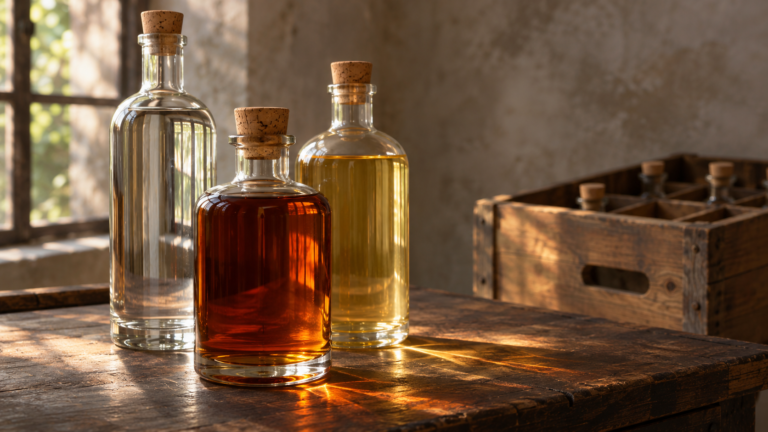
Featured image: AI-generated editorial illustration for The Food Eaters; does not depict a specific distillery, brand or distribution facility.