Understand Indian rojak’s selected ingredients and separate dipping sauce, its differences from Chinese rojak, and its place in Singapore’s street-food history.
Indian Rojak in Singapore: The Fritters, Sauce and Story Behind the Plate
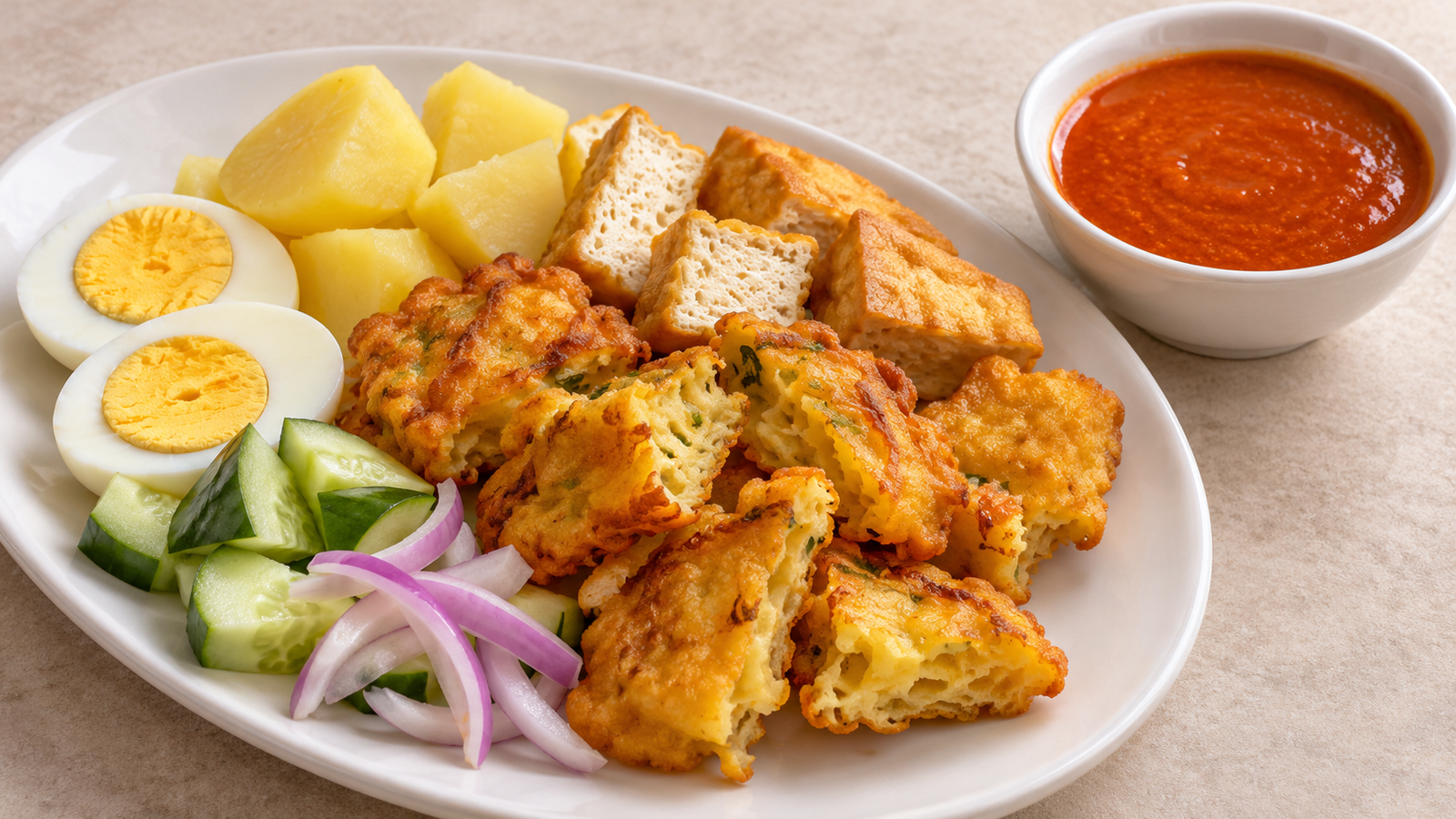
The sauce arrives alongside the food. That small detail is a useful introduction to Indian rojak in Singapore: a plate assembled from individual ingredients, with a dip that brings them together as you eat.
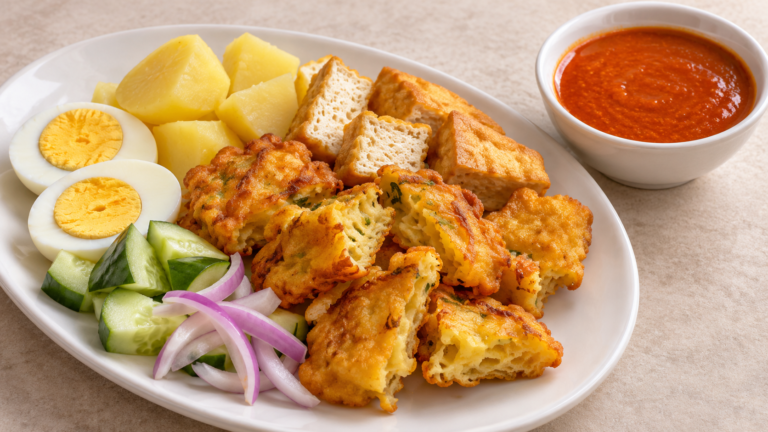
The National Heritage Board’s account of rojak describes customers selecting from a display that can include squid, fried beancurd and battered prawns. The ingredients are fried, cut into pieces and served with vegetables, with sauce on the side. Choosing the components is part of the dish’s structure.
For an Indian reader encountering the name, the plate offers a lesson in how food acquires a local identity. To understand it, look at both the selection in front of you and the Singapore street-hawker history behind it.
What goes on an Indian rojak plate?
Potatoes, eggs, tofu and battered prawns feature in the description published by the National Library Board’s BiblioAsia in its 2022 account of Singapore’s food culture. Chopped onion, cucumber and chilli accompany them, along with a sweet-spicy chilli dip.
Those ingredients are a guide to the format, not a compulsory checklist for every stall. The Heritage Board’s selection-based description helps explain why two orders need not look identical: the customer’s choices shape the finished plate.
If you are unfamiliar with the display, ask what an item contains before choosing it. A browned exterior does not tell you everything about a fritter’s filling. Identifying each component is more useful than ordering solely by its size or shape.
The sauce deserves its own explanation
Sweet potato is one documented ingredient in the sauce, but it should not be treated as proof of a single recipe followed throughout Singapore.
In its own Ministry of Rojak profile, Kiosks Collective describes a sweet-potato sauce used as the dip for its rojak platter. That gives a specific commercial example of the ingredient’s use. It does not establish the full contents of another stall’s sauce.
The separate serving also gives diners control over how much sauce accompanies each piece. Rather than assuming that the dip is an interchangeable accompaniment, ask the seller about its ingredients and preparation. It is part of what distinguishes one version from another.
Indian rojak and Chinese rojak are different plates
Rojak means “mixture” in Malay, as the NLB’s 2022 essay explains. Sharing that name does not make the two preparations equivalent.
| Feature | Indian rojak | Chinese-style rojak |
|---|---|---|
| Common components | Potatoes, eggs, tofu and battered prawns | Fruit and vegetables, including pineapple and cucumber, with beancurd and dough fritters |
| Sauce | Sweet-spicy dipping sauce served alongside | Dark dressing that can contain fermented shrimp ingredients, tamarind, chilli, sugar and peanuts |
| Assembly | Selected pieces with vegetables and a separate dip | Ingredients tossed with the dressing |
These are broad descriptions, not ingredient guarantees. In particular, a fruit-and-vegetable base does not establish that Chinese rojak is vegetarian: the fermented shrimp ingredients described by NLB matter to anyone making that choice.
A place in Singapore’s street-hawker history
Indian rojak appears in NLB’s history of hawkers during the colonial period. Its account lists the dish among foods sold by Indian hawkers, alongside mee goreng, vadai, muruku and kachang puteh. Sellers worked around street corners, schools and other gathering places.
This places rojak within an everyday trade in meals and snacks. It was part of the food available where people worked, studied and passed through the city, rather than a dish whose story begins with contemporary hawker-food lists.
Waterloo Street supplies a more specific setting. NLB’s Bras Basah food history identifies the street with Indian rojak and sarabat drink stalls. The same page reproduces a recollection from Rudolph William Mosbergen’s 2005 oral-history interview with the National Archives of Singapore. He remembered Indian rojak among Waterloo Street’s food offerings and a sarabat seller pouring tea between containers.
His recollection places Indian rojak alongside the drinks and other foods that shaped Waterloo Street’s everyday social life.
What can we say about its origins?
NLB’s 2013 essay Spicy Nation: From India to Singapore offers a possible explanation: Tamil-Muslim migrants adapted mee siam gravy, using mashed sweet potatoes to thicken it for a dipping sauce.
The essay presents that account tentatively. It is useful context for thinking about adaptation, but it does not settle a single inventor, exact birthplace or invention date.
The more firmly documented story is Indian rojak’s presence in Singapore’s hawker trade and public memory. That history is substantial enough to stand without a claim that one person created the definitive plate.
What to ask before ordering
Start with the components and the sauce. Ask what is inside unfamiliar fritters, whether the dip contains ingredients you avoid, and how your selection will be priced before the order is prepared.
For dietary requirements, discuss both the food and its preparation. Choosing vegetable pieces alone does not answer questions about the sauce or shared cooking equipment. If halal certification matters to your order, verify the particular outlet rather than inferring certification from the dish’s name.
Once those questions are settled, the selection becomes easier to understand: individual pieces, a separate dip and a combination shaped by the person ordering it. The historical record adds another layer, connecting that plate to the vendors and streets that helped make Indian rojak part of Singapore’s food culture.
Explore more stories about food traditions in our Culture archive.
Featured image: AI-generated editorial illustration for The Food Eaters; does not depict a specific hawker stall.