‘No added sugar’ does not mean sugar-free. FSSAI sets separate conditions for non-addition claims and for sugar-free claims on packaged foods.
‘No Added Sugar’ on Indian Food Labels: What FSSAI Actually Means
“No added sugar” sounds simple enough, but it does not mean the same thing as “sugar-free”.
Under FSSAI’s advertising and claims rules, the phrase has a specific meaning. A food can contain naturally occurring sugars and still qualify for a “no added sugar” claim, provided the product meets the conditions for a non-addition claim.
That distinction matters because the front of a pack can make a product sound much lower in sugar than it actually is.
What does FSSAI require for a “no added sugar” claim?
FSSAI’s current Advertising and Claims Regulations compendium says a food can make a non-addition-of-sugars claim only when several conditions are met. FSSAI’s current amendment index lists three amendments, the latest dated 13 December 2022; no later amendment is listed there as of 23 October 2026.
The rules say:
- no sugars of any type may be added to the food, including examples such as sucrose, glucose, honey, molasses or corn syrup;
- the food must not contain ingredients that themselves contain added sugars, such as jam, jelly, sweetened chocolate or sweetened fruit pieces;
- the food must not use sugar-containing ingredients as substitutes for added sugars, such as non-reconstituted concentrated fruit juice or dried fruit paste; and
- the sugar content must not be increased by another process, such as using enzymes to release sugars from starch.
So “no added sugar” is not just a claim that white table sugar was left out.
Can a “no added sugar” food still contain sugar?
Yes.
If sugars occur naturally in the ingredients, FSSAI allows the non-addition claim—but the label must also carry the statement below. FSSAI’s official Advertising & Claims FAQ repeats the same requirement:
“CONTAINS NATURALLY OCCURRING SUGARS”.
That is why a milk product, fruit product or another food with naturally present sugars may still carry a “no added sugar” claim.
The phrase tells you about what was not added. It does not tell you that the final food contains zero sugar.
How is “no added sugar” different from “sugar-free”?
They are separate claims under FSSAI’s framework.
For a product to claim it is sugar-free, FSSAI’s nutrient-claim criteria set a numerical limit: no more than 0.5 g of sugars per 100 g or 100 ml.
A “no added sugar” product can contain more sugar than that if the sugars occur naturally in its ingredients.
For example, a fruit-based product could contain naturally occurring sugars while making no addition of sugar. That does not make it sugar-free.
What should you look at besides the front-of-pack claim?
The nutrition table is the most useful next step.
Under FSSAI’s Labelling and Display Regulations, packaged foods generally declare both total sugars and added sugars in the nutrition information.
Those two numbers answer different questions:
- Total sugars includes sugars naturally present in the food as well as added sugars.
- Added sugars shows the sugars added during manufacture or preparation within the meaning of the labelling rules.
If a product says “no added sugar”, the claim should be consistent with the ingredient list and the nutrition information.
Does honey count as added sugar?
For the purpose of a non-addition-of-sugars claim, yes.
FSSAI specifically gives honey as an example of a sugar that cannot be added if the food is making a “no added sugar” claim.
This matters because honey, jaggery, molasses and similar sweeteners are sometimes marketed as more “natural” alternatives to sugar. Whatever their source, using them to sweeten a product is not compatible with a no-added-sugar claim under this rule.
What about fruit concentrate or date paste?
This is where the regulation becomes more specific.
FSSAI says a food making a no-added-sugar claim should not contain ingredients with sugars that are being used as substitutes for added sugars. The regulations give examples such as non-reconstituted concentrated fruit juice and dried fruit paste.
So the rule is designed to stop a manufacturer from avoiding the words “added sugar” while achieving the same sweetening effect through another concentrated sugar-containing ingredient.
Does “no added sugar” mean the product is low-calorie?
No.
Sugars are only one part of a food’s energy content.
A product with no added sugar can still contain calories from naturally occurring sugars, starch, fat or protein. It can also be a calorie-dense food for reasons completely unrelated to sugar.
The claim should therefore be read as a statement about formulation—not as an overall rating of the food.
Does it mean the product is healthier?
Not automatically.
A no-added-sugar claim may be useful information for someone specifically trying to reduce added sugars, but the label still needs context.
Look at:
- the ingredient list;
- total sugars;
- added sugars;
- serving size;
- overall energy; and
- other nutrients such as sodium and saturated fat where relevant.
The same principle applies to other nutrition marketing. Our article on high-protein food marketing looks at why one positive-sounding claim should not substitute for reading the rest of the label.
Compare the same quantity, then your portion
Start with the same basis on both packs: per 100 g, per 100 ml or an equivalent serving. A smaller stated serving can make a number look lower without changing the concentration of sugar in the food.
For illustration, if a food’s panel states 8 g of total sugars per 100 g, a 150 g portion supplies 12 g of total sugars. That arithmetic does not reveal how much was added; read the separate added-sugars entry. These are invented numbers to demonstrate the calculation, not a claim about a named product.
A useful shopping sequence is to read the claim, look for the naturally occurring sugars statement where applicable, check the ingredients, and then compare the nutrition panel. For another common set of packaging terms, see our guide to “natural”, “pure” and “real” food claims.
FSSAI Advertising and Claims Regulations, the current amendments index and related labelling requirements checked as of 23 October 2026.
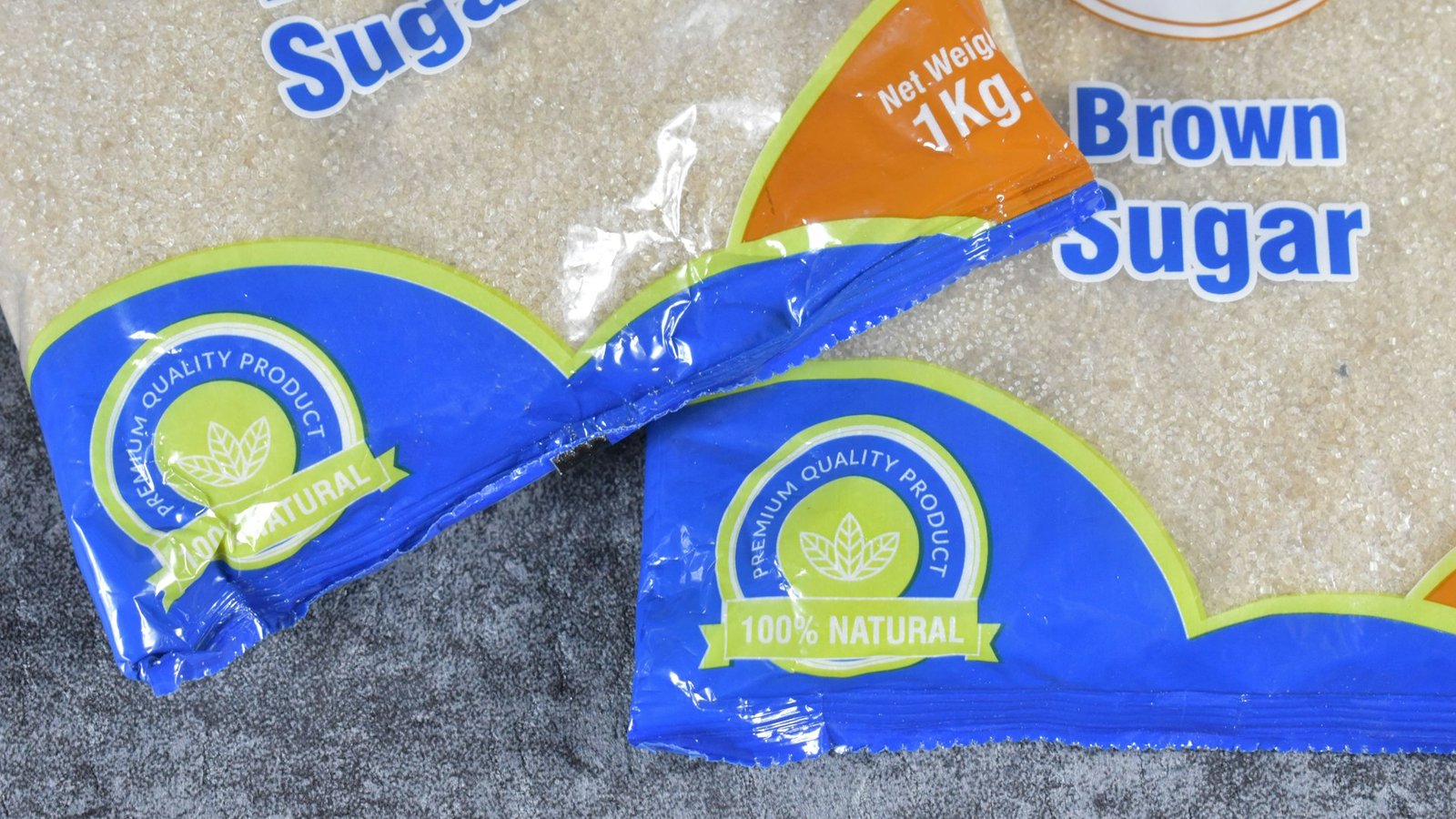
Featured image: Photo by Jake Bravo / Unsplash, under the Unsplash License. Illustrative bags of brown sugar; the pictured products are not presented as examples of a no-added-sugar claim or a regulatory violation.