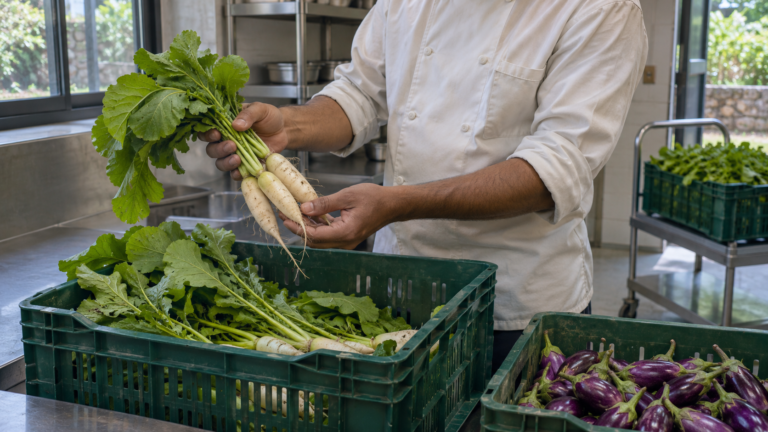
From restaurant gardens to specialist grower networks, the work behind a seasonal menu extends well beyond the harvest. The harder questions concern reliable supply, handling costs and who carries the risk.
Behind India’s Farm-to-Table Menus
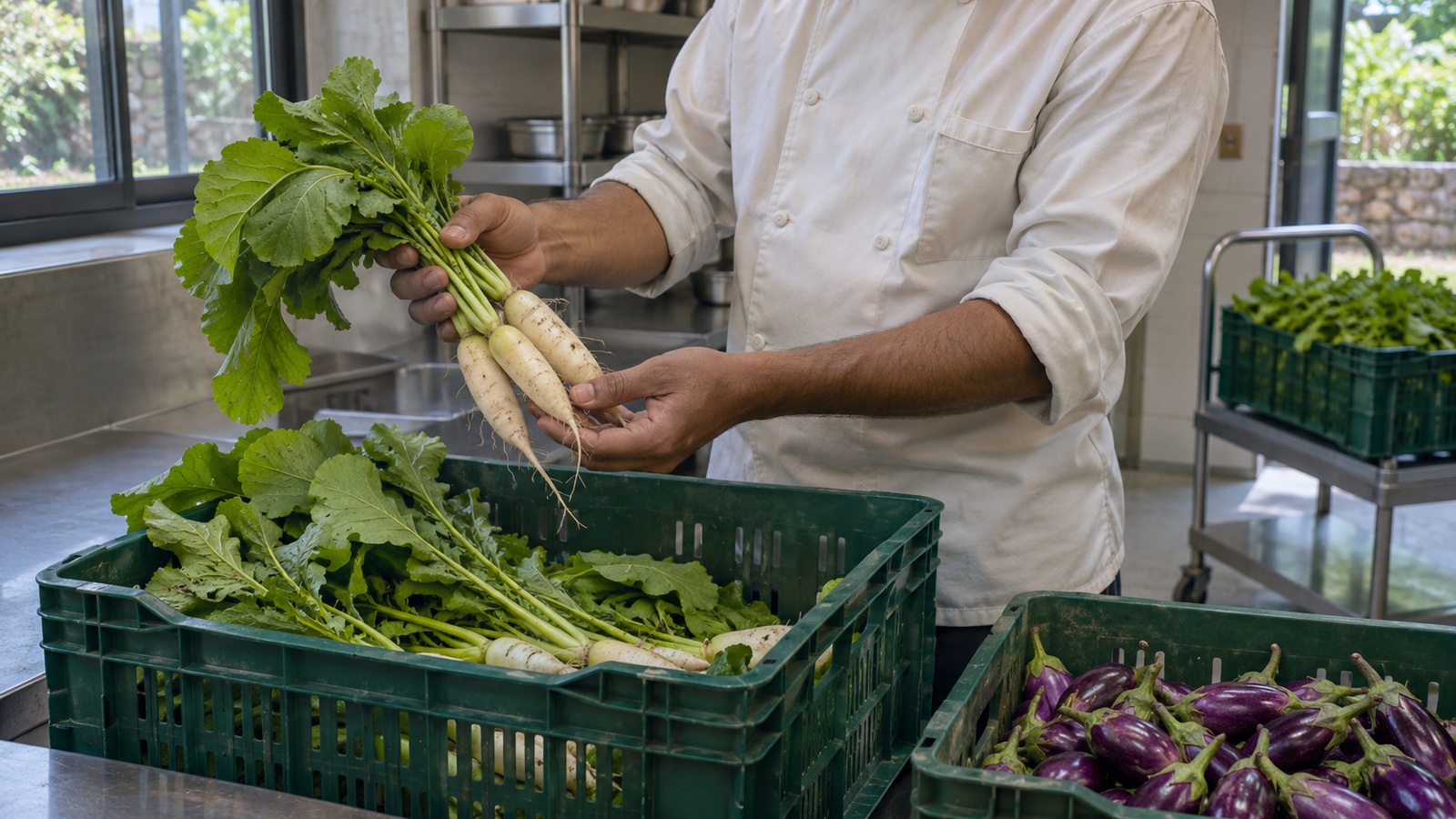
AI-generated editorial illustration for The Food Eaters; does not depict a specific restaurant or supplier
A farm-to-table menu tells a story about where an ingredient began. The phrase alone does not explain how that ingredient reached the kitchen: who planned the crop, checked the harvest, packed the crates, arranged delivery or found a replacement when the required quantity was unavailable.
Those details distinguish one sourcing model from another. A restaurant growing food beside its kitchen operates differently from a city restaurant supplied by an associated outlying farm. Both differ from a chef buying through a specialist producer network. Each can bring a kitchen closer to agricultural decisions. None, by itself, proves that the restaurant has stopped using conventional suppliers.
In Bengaluru, Mumbai and the supply networks serving Delhi, the useful story lies in those arrangements—and the costs and responsibilities that remain after a menu names a farm.
A farm beside the kitchen
At FarmLore outside Bengaluru, founder Kaushik Raju’s farm and co-founder and head chef Johnson Ebenezer’s kitchen are part of the same project. The restaurant describes orchards, seasonal growing and hydroponics alongside its broader farm ecosystem. Its account of the kitchen garden includes raised beds and composting, with material from the kitchen returned to the soil.
This gives the restaurant a direct connection to growing, although its published descriptions provide no procurement breakdown showing how much of the menu comes from the estate.
The dining format offers a more concrete indication of how availability enters service. FarmLore’s booking terms describe a reservation-only tasting menu that changes with seasonality and available ingredients. Guests commit to a sequence rather than choosing from an à la carte menu.
Operationally, that format gives a kitchen room to decide what it will serve before diners arrive. It is a useful distinction from promising a long list of dishes every day. The format helps explain how seasonal purchasing can be organised. Its effects on waste and profitability would require separate measurement.
Mumbai’s different routes to the farm
The Table’s own account describes a supporting farm established in Sasawne, Alibag, in 2012, at the property of co-founders Jay Yousuf and Gauri Devidayal. Adrienne Thadani of Good Karma Farms helped establish it. The restaurant lists vegetables, herbs and fruit among the harvests destined for its kitchen, including heirloom tomatoes, lettuces and edible flowers.
The same page also describes a procurement approach that includes both local sourcing and imported ingredients. That combination matters. The farm is an identifiable part of the supply system, rather than proof that the entire menu is locally grown.
Masque describes another arrangement. Founded by Aditi Dugar and with Varun Totlani leading the kitchen, it says its seasonal menus draw on farmers, producers and foraging trips. Its research kitchen, Masque Lab, provides a place to explore ingredients and techniques.
Here, the restaurant’s stated model connects sourcing with menu development. Its public account leaves the purchasing proportions, payment terms and frequency of individual supplier deliveries unspecified.
For a broader view of these kitchens and their place in contemporary dining, see our guide to 25 restaurants shaping India’s dining scene.
A shorter chain can still need an intermediary
The networks behind restaurants deserve attention in their own right. OOO Farms describes work with indigenous farming communities in Maharashtra and Gujarat, including safeguarding native seeds and encouraging traditional agricultural practices. Its account places seed continuity and producer relationships alongside the sale of rice, pulses and millets.
Seed conservation extends the sourcing story beyond the kitchen. Verifying individual varieties would require provenance records; assessing farmer returns would require evidence from the producers as well as the seller.
Delhi’s Krishi Cress, founded by Achintya Anand, shows how growing and distribution can sit within one business. Its company history describes a microgreens beginning and the subsequent development of a packing unit and hospitality supply network. Today, it describes produce from its own farms in Uttar Pradesh alongside partner farms in other regions.
The Delhi example here concerns a grower-distributor rather than a documented purchasing arrangement at an individual restaurant. This is not a purely neighbourhood-scale model. Nor is the distributor’s role automatically a failure of direct sourcing. Packing, consolidating orders and organising transport are services a kitchen still needs, whether they are performed by a wholesaler, a specialist grower or the restaurant itself.
Buying directly does not make delivery free
Krishi Cress explicitly links its pricing to work after harvest: rapid cooling, cold storage, temperature-controlled transport, crates and food-safe packaging. That is the supplier’s explanation of its costs, not an independently audited comparison with competing businesses.
It nevertheless identifies an important distinction. The price paid for a crop is only one part of the cost of getting usable produce into a restaurant.
As an operating-cost calculation, a kitchen needs to consider transport, receiving and preparation labour, storage and the proportion of a delivery it can actually use. A lower purchase price can be offset by extra collections or rejected stock. Growing on a farm operated by a restaurant or its founders introduces another set of costs, including cultivation labour and maintaining the growing infrastructure. These are considerations for assessing a model, not claims that the restaurants named here incur identical expenses.
Supply planning raises a related question: what happens when the farm’s harvest and the restaurant’s demand do not match? A credible arrangement needs decisions about order quantities, acceptable variation, substitutions and payment. If a restaurant requests a particular crop, the commercial terms should make clear who bears the loss if demand changes.
The available operator accounts do not establish a common cost premium, a consistent farmer-income improvement or the proportion of purchasing that has shifted away from wholesale markets. Presenting these examples as proof of a nationwide supply-chain transformation would go further than the evidence allows.
Knowing the grower is only part of knowing the food
A close supplier relationship can make it easier to ask how an ingredient was grown and handled. It cannot replace checks at delivery or appropriate storage in the kitchen. Our guide to restaurant hygiene in India explains the wider food-safety questions diners should consider.
Buying directly from a grower does not remove a restaurant’s food-safety responsibilities. Applicable Schedule 4 requirements depend on the business’s registration or licensing status and activities. FSSAI’s catering guidance explains receiving checks, including spoilage, packaging condition, appropriate delivery temperatures and purchasing quantities suited to storage capacity. The guidance supports implementation; it does not replace the regulations.
Certification is another separate question. Krishi Cress states that it is not certified organic. That disclosure illustrates why diners should not treat “local”, “farm-sourced” and “certified organic” as equivalent descriptions.
What a sourcing claim should tell the diner
The most useful explanations are specific: which ingredient comes from which producer, whether the relationship is current, and how the kitchen responds when the crop changes. A farm name can make a menu more informative. It cannot, on its own, establish lower emissions, fairer payment or superior food safety.
Farm-to-table becomes meaningful when the restaurant can explain the work behind the phrase. The harvest is one part of that account. The handling, purchasing decisions and treatment of the people growing the food deserve a place in it too.