What is nolen gur? Understand Bengal’s date-palm jaggery, liquid gur and patali, the sweets to try, and the questions worth asking before buying.
Nolen Gur: How to Buy Bengal’s Winter Jaggery and Choose Your First Sweets
A jar of nolen gur and a box of gur sandesh promise different things. One gives you an ingredient to use at home; the other is a sweet-maker’s interpretation of it. Before buying either, it helps to know what the name describes—and what it leaves unanswered.
Nolen gur is Bengal’s seasonal date-palm jaggery. As winter approaches, it offers a more interesting way into Bengali sweets than another list of the “best mithai shops”: follow the ingredient, ask when it was made and choose the form that suits how you want to eat it.
What is nolen gur made from?
Date-palm sap is heated to concentrate it into jaggery. It is not made by crushing ripe dates, and it should not be confused with ordinary sugarcane jaggery. The West Bengal Khadi and Village Industries Board’s Majdia project describes nolen gur as liquid date-palm jaggery and documents its packaging in tubes in Nadia district.
That matters at the shop counter. “Gur” alone is a broad description. If you specifically want the date-palm product, ask for khejurer gur and check what the seller actually supplies. A brown colour, a rustic pot or a handwritten “pure” label is not a substitute for an ingredient description.
Liquid gur and patali: choose by use
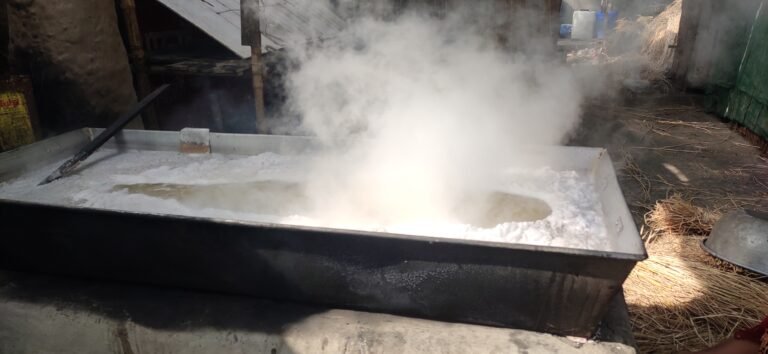
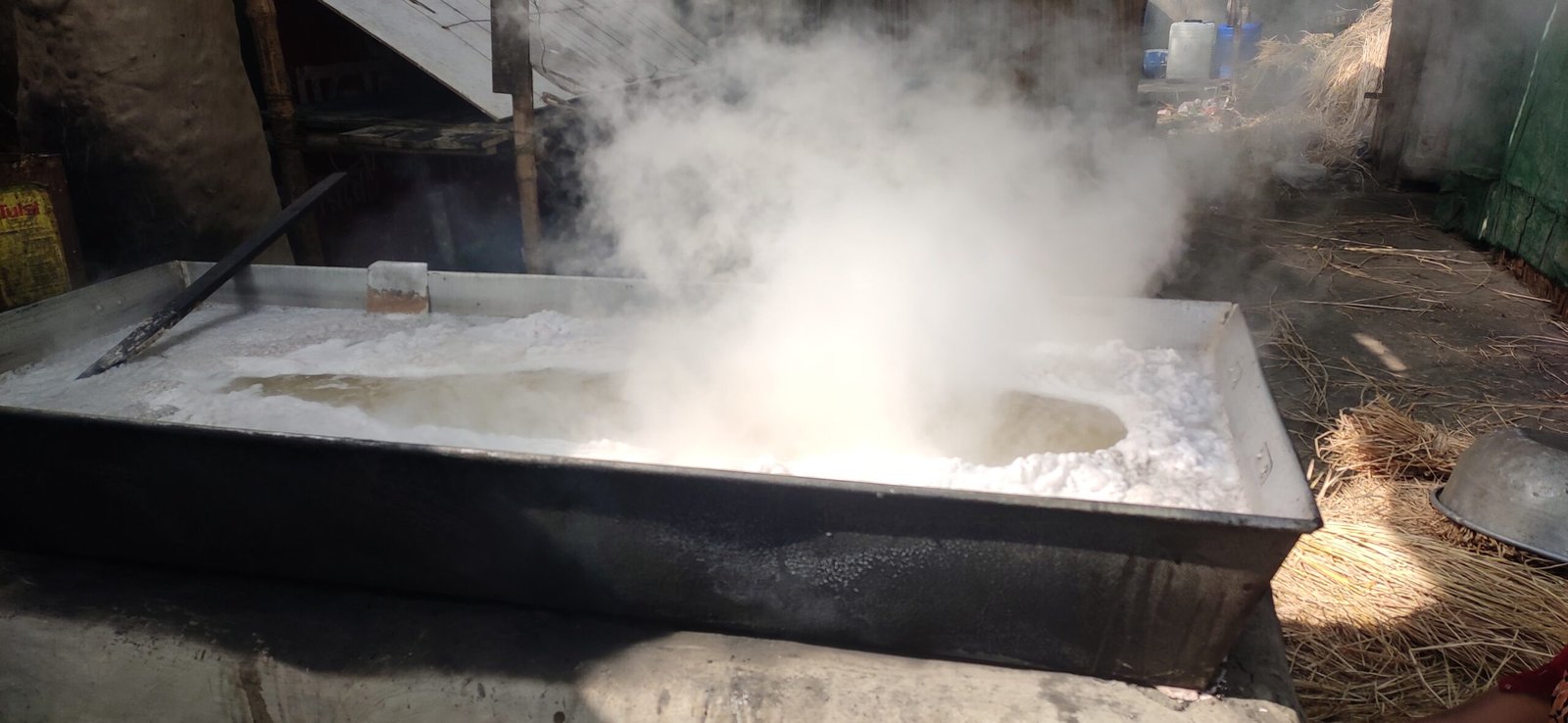
Liquid gur is the practical choice when you want to spoon or pour it. Patali is the set form, sold in cakes or blocks that can be broken up for cooking. The photographer’s documented jaggery-making process at Gangasagar shows the connection: concentrated sap can remain a thick syrup or be reduced further into solid cakes.
Neither format automatically establishes quality. Choose according to the job. For a little finishing sweetness, a small quantity of liquid gur is convenient. For a recipe that specifies patali, buy that form instead of assuming that an equal volume of syrup will behave identically. Water content and consistency affect a dish as well as sweetness.
Three ways to begin tasting it
Start with sandesh if you want a small portion. A gur version lets you explore the ingredient in a chhena-based sweet without committing to a large dessert. Kolkata sweet-maker Balaram Mullick & Radharaman Mullick includes nolen gurer guli sandesh in its account of the family’s confectionery history. That documents a longstanding use; it does not guarantee that every branch stocks it today.
Choose payesh if you prefer a spoon dessert. The combination of milk, rice and date-palm jaggery is one of the established uses recorded in reporting on Bengal’s jaggery traditions. Ask whether the shop’s version is made with gur throughout or finished with it; those are different preparations.
Look for patishapta when you want the filling to matter. This rolled sweet can carry coconut and jaggery, but fillings vary. Ask what is inside rather than treating the name as a fixed recipe. For a first purchase, two different small sweets will tell you more than a large mixed box whose ingredients are unclear.
What “seasonal” should prompt you to ask
Winter is central to the ingredient’s identity, but there is no single arrival date that applies to every shop. A product sold outside the harvest period may use stored jaggery. That is a reason to ask about production and storage, not proof that the product is fraudulent.
For this season’s shopping, ask when the jaggery was produced, whether other sweeteners are included and whether the product is liquid gur, patali or a prepared sweet. For packaged purchases, read the ingredient list and follow the maker’s storage instructions. For loose sweets, request a preparation date and a clear storage recommendation, especially if the box will travel.
Buy a quantity you can realistically use. A large jar is poor value if you bought it for a single recipe and have no plan for the remainder. Keep the producer’s label or receipt so you can return to the same product if it works for you.
Our guide to “natural”, “pure” and “real” food claims explains why attractive packaging language deserves a closer look. For the wider setting, read about food and celebration in West Bengal. Here, the most useful starting point is smaller: know which gur you are buying, then let the sweet-maker explain what they have done with it.
Featured photograph: date-palm jaggery preparation at Gangasagar, photographed on 8 January 2026 by Goutam1962 / Wikimedia Commons, CC BY-SA 4.0. Resized for display; the photograph is not a report of this autumn’s harvest. Image derivatives remain under the same licence.