India does not have one biryani for every state. Its real story is more interesting: migration, courtly kitchens, local rice, trading communities and regional tastes created many overlapping traditions.
Why India Has So Many Regional Styles of Biryani
India does not have one officially defined biryani for every state.
The truth is less tidy and far more interesting.
Biryani traditions can belong to a city, a court, a trading community, a religious community, a family or a restaurant tradition that later becomes identified with an entire region. Two cooks living in the same city may disagree about the correct rice, spice balance or cooking sequence.
Even the origin of biryani in India resists the neat stories often repeated about it.
Popular accounts attribute the dish to individual emperors, queens or dramatic moments of royal necessity. A detailed 2025 examination by Indian Express argues that many familiar royal-origin stories are unsupported and that the history is better understood through the movement and evolution of rice-and-meat traditions over time. Read the Indian Express history of biryani and its common myths.
That complexity is exactly why Indian biryani varies so much.
Hyderabad: the Deccan makes biryani its own
Hyderabadi biryani is often described simply as a Mughal inheritance. The regional history is more layered.
The Deccan absorbed Persianate, local and later Mughal culinary influences over long periods, while Hyderabad’s courtly food culture developed its own identity.
The famous distinction between kacchi and pakki methods is one example of how technique can define a biryani.
In kacchi preparations, marinated raw meat and rice are assembled and cooked together under dum, requiring careful control of moisture and timing. Pakki versions use meat that has already been cooked or partly cooked before the final assembly.
Even within Hyderabad, recipes are not uniform.
The useful point is not to find a single “authentic” formula, but to understand that Hyderabadi biryani emerged from the Deccan’s own political, agricultural and culinary history.
Lucknow and Awadh: delicacy, yakhni and dum
Awadhi food offers a different meat-and-rice vocabulary.
Historical writing on Lucknow notes that pulao held an especially prestigious place in Awadhi cuisine, complicating modern attempts to treat every royal rice dish as biryani.
Contemporary Lucknowi or Awadhi biryani is commonly associated with a more restrained spice profile and a method in which rice and meat are cooked or partly cooked separately before being layered and finished under dum.
That distinction shows why regional biryani cannot be reduced to different masala mixes.
Technique matters.
Stock matters.
The degree to which rice absorbs the meat’s cooking liquid matters.
Even the relationship between pulao and biryani changes depending on the culinary tradition being discussed.
Kolkata: migration transforms an Awadhi inheritance
Kolkata biryani is one of the clearest examples of food travelling with people.
After the British removed Wajid Ali Shah from the throne of Awadh, he eventually established a court-like household at Metiabruz near Calcutta. Historical reporting documents how members of his entourage and culinary culture travelled with him. Read the historical account of Wajid Ali Shah’s exile and life in Calcutta.
Indian Express has also documented the culinary connection directly: when Wajid Ali Shah arrived in Metiabruz, his entourage included cooks who carried Awadhi kitchen traditions into Bengal. Read the account of Wajid Ali Shah and Kolkata biryani.
The potato eventually became one of the most recognisable signatures of Kolkata biryani.
But the familiar explanation that potatoes were introduced simply because the exiled ruler was too poor to afford enough meat deserves caution.
A more recent Indian Express examination describes that cost-cutting story as improbable and notes that Wajid Ali Shah continued to have financial resources in exile. It also points out that potato was not universally part of every Kolkata biryani tradition historically; one well-known old restaurant added it only much later. Read the 2025 examination of the Kolkata biryani potato story.
That is an important lesson in food history.
A compelling anecdote is not automatically a documented origin.
Kolkata biryani’s connection to Awadhi migration is well supported. The exact story of how its potato became standard is less certain.
Ambur and Dindigul: Tamil Nadu changes the rice
Regional identity can begin with the grain itself.
In much of northern India, biryani is closely associated with long-grain basmati. Tamil traditions show why that assumption cannot be universal.
Ambur and Dindigul are strongly associated with seeraga samba, a small, aromatic rice whose texture and flavour produce a very different dish from basmati-based biryani.
Ambur’s history is also connected to Tamil Muslim cooking and the wider Arcot region, while Dindigul developed its own recognised approach.
Calling both simply “Tamil biryani” therefore hides almost as much as it explains.
Cities can matter as much as states.
Local rice can matter as much as spice.
Thalassery and Malabar: a different grain, a different coastal history
Kerala’s Malabar coast adds another set of influences.
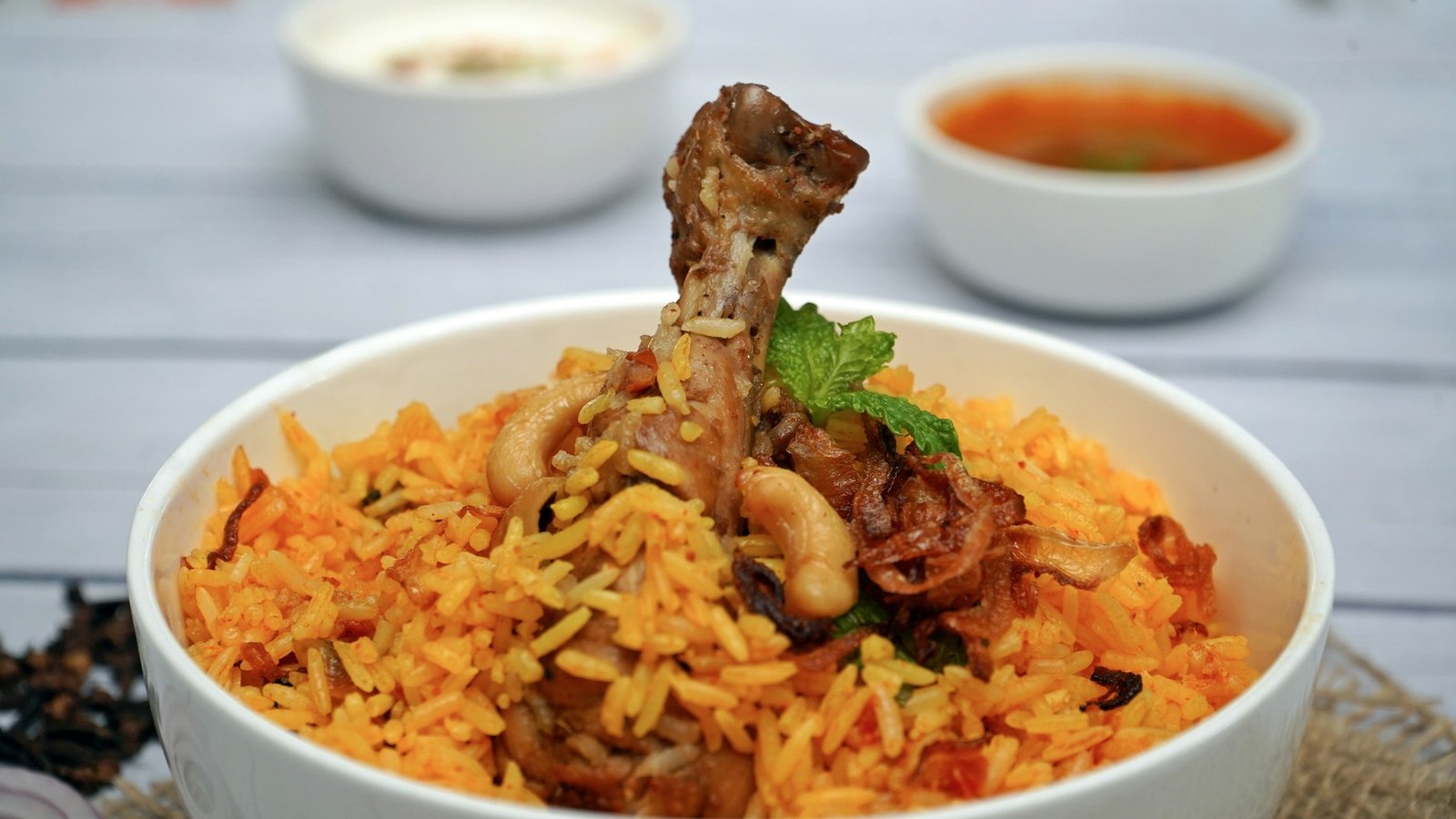
The Kerala Department of Tourism describes Thalassery biryani as a dum-cooked preparation using fragrant Jeerakasala rice, layered with ingredients including chicken, caramelised onions, cashews and raisins. Kerala Tourism’s guide to Thalassery Dum Biryani.
Kerala Tourism’s material on Mappila cuisine also traces that food culture to the long interaction between Arab traders and local Kerala traditions and identifies Jeerakasala, or Kaima, as the rice traditionally associated with Malabar biryani. Kerala Tourism’s Mappila cuisine and biryani history.
That does not mean one trading encounter “invented” Thalassery biryani.
Food traditions rarely emerge so neatly.
It means the region’s rice dishes developed in a coastal environment shaped by trade, migration, religion and local agriculture—conditions very different from those of Lucknow, Hyderabad or Kolkata.
What actually makes a biryani regional?
The easiest way to understand biryani’s diversity is to stop treating the map as the recipe.
Several factors can change the dish dramatically.
Rice: basmati, seeraga samba and Jeerakasala behave differently and carry different regional associations.
Cooking sequence: meat may be raw, cooked or partly cooked before layering. Rice can be parboiled to different stages. Some traditions rely heavily on dum; others use different assembly methods.
Fat and aromatics: ghee, oil, browned onions, herbs, saffron, floral waters and spice combinations vary enormously.
Acidity and heat: yoghurt, tomato, citrus, chilli and other souring or hot ingredients can move the balance of a biryani in completely different directions.
Protein: goat or mutton may dominate one tradition; chicken, fish or beef may be important elsewhere. Vegetarian biryanis have their own histories and audiences.
Community: royal kitchens, Muslim trading communities, migrants, commercial cooks and home kitchens all shaped different versions.
Local agriculture: cooks tend to build with ingredients that are culturally valued and realistically obtainable around them.
That is why a regional biryani is rarely just a recipe with a place name attached.
It is a record of movement.
Biryani is a family of traditions, not a state-by-state checklist
The temptation to create a list of “28 states, 28 biryanis” is understandable. It makes a complicated food culture easy to package.
It also makes the history less accurate.
India’s biryanis overlap. They borrow. They migrate. A cooking technique can move from a royal kitchen into a commercial restaurant and then into thousands of homes. A local rice can transform a dish that arrived from elsewhere. A displaced court can reshape the food of another city.
Hyderabad, Lucknow, Kolkata, Ambur, Dindigul and Thalassery do not matter because they complete a map.
They matter because each shows a different way that history can enter a pot of rice.
That is the more compelling story behind India’s many biryanis.