India’s café market is expanding through very different models, from specialty sourcing and large-format cafés to compact takeaway stores. Meet five founder teams shaping that growth.
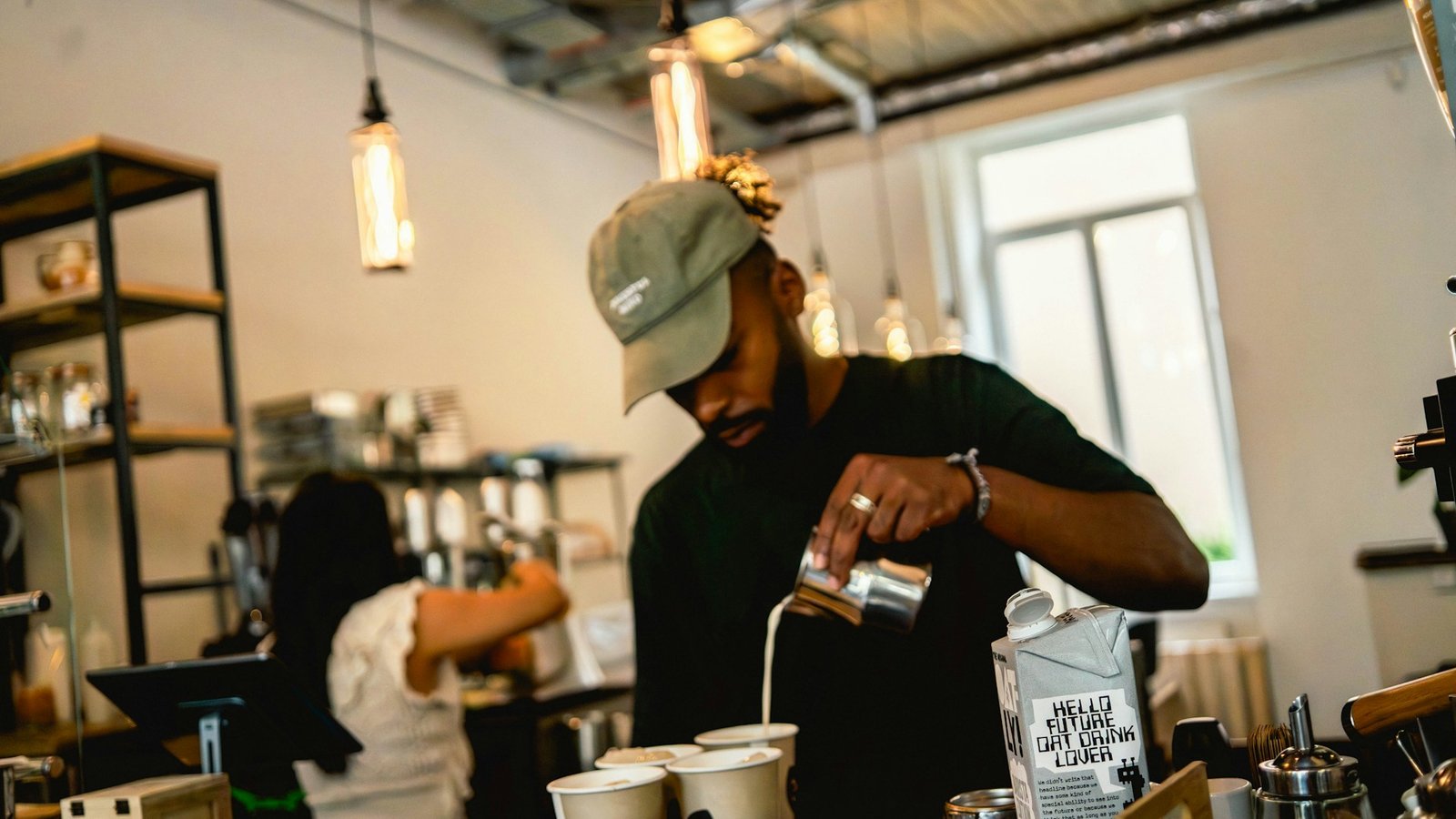
India’s café expansion cannot be reduced to a single growth story.
Some brands are building large specialty-coffee networks. Others are betting on compact stores designed around speed. Some are expanding aggressively beyond metros; others are using roasting, sourcing and hospitality as the centre of their identity.
That is why calling any one group the country’s “fastest-growing café chains” without a shared measurement would be misleading.
Outlet counts are reported on different dates. Some companies count kiosks alongside cafés. Others talk about targets rather than operating stores. Revenue growth and store growth are not the same thing.
A more useful question is this:
Who is building India’s expanding café brands, and what are they building differently?
Five companies provide five distinct answers.
Blue Tokai Coffee Roasters — Matt Chitharanjan, Namrata Asthana and Shivam Shahi
Blue Tokai’s story began before India’s current specialty-coffee boom looked inevitable.
Matt Chitharanjan and Namrata Asthana started Blue Tokai in 2013, with Shivam Shahi later joining as co-founder and COO. Moneycontrol identifies all three as the company’s founders in its reporting on the business. Read Moneycontrol’s profile of Blue Tokai and its founders.
By July 2026, parent company Muhavra Enterprises was operating 240 outlets across India, according to Business Standard, which reported Chitharanjan’s longer-term expansion plans. Read Business Standard on Blue Tokai’s 240-outlet network.
The company has expanded far beyond packaged beans into cafés, roasting and a broader food-and-beverage business.
Its importance to the category is not simply scale.
Blue Tokai helped make origin, roast profile and brewing method part of mainstream café vocabulary in Indian cities. The model starts with coffee as an agricultural product, then builds retail around it.
Third Wave Coffee — Sushant Goel, Anirudh Sharma and Ayush Bathwal
Third Wave Coffee has pursued a different version of the specialty-café opportunity.
The company was founded by Sushant Goel, Anirudh Sharma and Ayush Bathwal. Moneycontrol documented the founding team in August 2026 while reporting the company’s latest funding and expansion plans. Read Moneycontrol on Third Wave Coffee and its founders.
The most current reported network figure is now 250 cafés.
On September 26, 2026, ETRetail reported that Third Wave had opened its 250th café in Hazratganj, Lucknow. The company continues to target approximately 320 cafés by FY27. Read ETRetail on Third Wave Coffee’s 250th café.
That second number remains a target, not a current outlet count.
Third Wave’s expansion has included metros as well as emerging café markets across India.
The company illustrates a central question in café scaling: how far can a specialty-coffee identity stretch before a company effectively becomes a broader all-day food-and-beverage chain?
For large café networks, coffee quality still matters, but location density, menu breadth, digital ordering, seating and repeat daily use increasingly matter too.
abCoffee — Abhijeet Anand
abCoffee approaches café growth from the opposite physical direction.
Rather than making every outlet a long-stay café, the company has focused heavily on compact stores and fast transactions.
ETEntrepreneur reported in May 2026 that Abhijeet Anand founded abCoffee in 2022 and that the company was operating more than 90 outlets, with expansion focused on dense office, residential and transit-led locations. Read ETEntrepreneur on Abhijeet Anand and abCoffee’s 90-plus outlets.
The format says something important about the evolution of café demand.
Coffee does not always need to be an occasion. A smaller store can compete for the customer who wants a reliably prepared drink between meetings, during a commute or on the way to work.
That makes abCoffee’s model less about recreating the European coffeehouse and more about increasing the frequency with which purchased coffee fits into an ordinary weekday.
Nothing Before Coffee — Ankesh Jain, Anand Jain, Akshay Kedia and Shubham Bhandari
Nothing Before Coffee began in Jaipur in 2017 with four founders: Ankesh Jain, Anand Jain, Akshay Kedia and Shubham Bhandari. The company’s current public material identifies the same four-member founding team. See Nothing Before Coffee’s current founder information.
Its geography helps distinguish it from a café story written only through Bengaluru, Mumbai and Delhi.
In July 2026, ETRetail reported that Nothing Before Coffee had reached 109 outlets during FY26, up from 86 a year earlier, across 45 cities and 12 states. Read ETRetail on Nothing Before Coffee’s FY26 outlet count.
That figure describes the FY26 reporting period. The brand has continued opening stores since then, so it should not be read as a live ceiling on the network.
Nothing Before Coffee’s expansion reflects the increasing depth of café demand in tier-two and tier-three markets as well as metros.
Its positioning has leaned toward accessibility and a broad beverage menu rather than presenting coffee only as a connoisseur product.
The broader lesson is that India’s coffee-market growth does not have to follow a single premium template.
Roastery Coffee House — Nishant Sinha
Roastery Coffee House presents yet another model: a founder-led café brand where roasting, hospitality and destination spaces remain central.
Roastery’s own company history says Nishant Sinha founded the business in 2017 after beginning his career as a barista and working in India’s coffee industry. Read Roastery Coffee House’s official founder story.
The company’s current official website states that it operates 11 cafés across India. See Roastery Coffee House’s current café network.
That makes it smaller in outlet count than some of the networks above, which is precisely why “fastest-growing” would be the wrong frame for this article.
Roastery belongs in the conversation because it represents a different ambition: building a recognisable coffee and hospitality brand without treating maximum store density as the only measure of relevance.
Its official history also records the opening of its first global outlet in Helsinki in 2024.
There is no single Indian café-growth formula
Put these businesses side by side and the differences become more interesting than the ranking.
Blue Tokai built strongly around sourcing and roasting. Third Wave has combined specialty coffee with a large café network and broader food proposition. abCoffee is testing a dense, compact convenience model. Nothing Before Coffee is expanding across a wider range of Indian cities. Roastery keeps a stronger destination-hospitality identity while taking an Indian café brand overseas.
Those strategies will not produce identical outlet economics or identical customers.
They also should not be compared through loose superlatives.
The more significant story is that Indian café culture has become large enough to support multiple business models at the same time.
Coffee can be agricultural storytelling.
It can be a workspace.
It can be a fifteen-minute meeting.
It can be a quick takeaway on a commute.
It can be an all-day café meal.
And increasingly, the brands defining those occasions are being built in India.