A practical Old Delhi food route connecting Chandni Chowk’s classic snack shops with Jama Masjid and Matia Mahal, using current Delhi Tourism and 2026 reporting.


1


A practical Old Delhi food route connecting Chandni Chowk’s classic snack shops with Jama Masjid and Matia Mahal, using current Delhi Tourism and 2026 reporting.
Old Delhi is better approached as a route than as a giant food checklist. The lanes are crowded, the distances can be deceptive and many of the classic dishes are rich enough that trying to eat at every famous stop in one afternoon quickly becomes impractical.
Delhi Tourism’s food-tour material groups many of the best-known names — including Giani’s Di Hatti, Jung Bahadur Kachori Wala, Natraj Dahi Bhalla, Old Famous Jalebi Wala, Abdul Ghani Qureshi Kabab Corner and Karim Hotels — into its Old Delhi coverage.
A sensible self-guided route starts near Fatehpuri, moves east through Chandni Chowk and finishes around Jama Masjid and Matia Mahal. Share portions and allow more time than the map suggests.
Delhi Tourism says Giani’s Di Hatti began as a single shop in 1956 and is known for rabri falooda alongside dishes such as chole bhature and rajma chawal. Its current tourism listing shows the outlet open daily from 8:30 a.m. to 11 p.m.
Starting here places you at the western end of Chandni Chowk. A shared falooda is enough if several savoury stops are planned afterwards.
Delhi Tourism’s Old Delhi food guide identifies Natraj Dahi Bhalla near the Chandni Chowk metro side of the market and describes its dahi bhalla as urad-dal dumplings covered in curd and chutneys.
This is another stop where sharing works better than ordering individual full portions if the route continues through the afternoon.
The same Delhi Tourism guide lists Jung Bahadur Kachori Wala as a well-known Old Delhi specialist for urad-dal kachori with aloo sabzi and gives a daytime schedule in its current listing.
Treat it as a focused snack stop rather than trying to build a full meal around every lane.
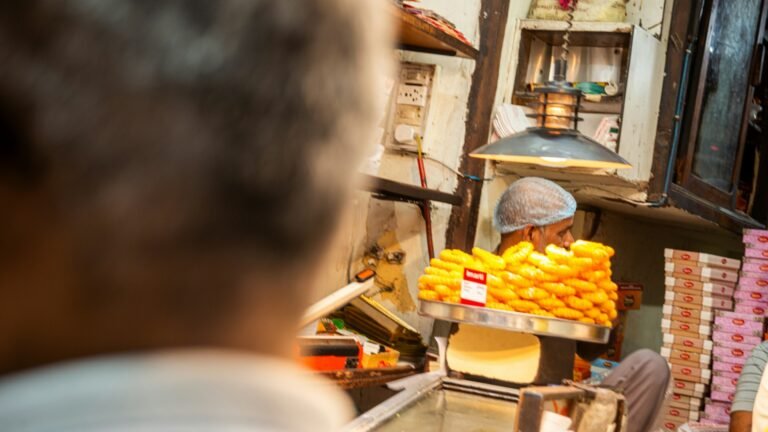
Delhi Tourism traces Old Famous Jalebi Wala to 1884 and currently lists it open daily from 8 a.m. to 10 p.m.
The obvious order is the jalebi. Sharing a portion keeps the route manageable before the heavier Jama Masjid section.
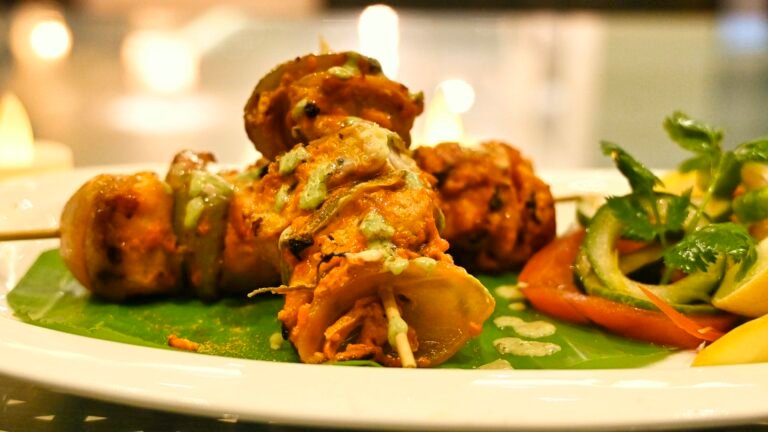
The food character changes as the route moves toward Jama Masjid and Matia Mahal. Delhi Tourism highlights the area for kebabs, fried foods and Mughlai restaurants, with Karim’s among its best-known historic names.
The tourism department’s food-tour directory also includes Abdul Ghani Qureshi Kabab Corner among the recognised stops in this part of Old Delhi.
This final section works best as the route’s main savoury meal rather than another series of large tasting portions.
Daulat ki Chaat is seasonal, not a permanent all-day stop. A January 2026 Indian Express feature describes it as a winter-only Old Delhi dessert that is found in the early morning and disappears before noon as the delicate milk froth loses its structure.
If this is the priority, plan the day around it first rather than expecting to add it casually at the end of an afternoon walk.
For a very different stop, Bundu Haleem near Matia Mahal is a specialist operation documented by The Indian Express in August 2026. The report traces the business to 1953, says it still focuses on a single haleem recipe, and notes that the pot can sell out during the afternoon.
Because that schedule is different from a standard dinner restaurant, it is better treated as a dedicated stop rather than something guaranteed to be available late in the day.
Allow roughly three to four hours for the main Fatehpuri-to-Jama Masjid route. The geographic distance is manageable, but crowds, queues, navigation and breaks slow the pace.
Use the metro where practical and check same-day opening information for any shop that matters to the plan. Old Delhi’s historic reputation is part of the attraction, but a historic business can still change its operating hours.
The route works best when it shows the change in food culture across the neighbourhood: sweets and snacks around Chandni Chowk, then the denser Mughlai traditions around Jama Masjid and Matia Mahal. There is no need to turn the experience into a count of how many famous shops can be completed in one day.